Late Spring Wind Storm Tree Risks in Oregon City Yards
Late spring in Oregon City brings something most residents already know to expect: wind. But not the mild Pacific breeze that makes the Willamette Valley so livable. Late May and early June often deliver sustained gusts that ride over the West Linn ridgelines and funnel through the I-205 corridor with enough force to pull trees out of saturated ground roots and all. After a wet winter and a soggy spring, the soil along Beavercreek Road, Molalla Avenue, and in the older neighborhoods near McLoughlin Boulevard holds water like a sponge. That saturation, combined with heavy tree canopies that haven't yet shed spring growth, creates the conditions for some of the most serious residential tree failures of the year.
Why Late Spring Is the Most Dangerous Wind Season for Trees
Most homeowners assume winter is the riskiest time for wind damage. In reality, late spring creates a more dangerous combination of factors. Trees have just pushed out new foliage, which dramatically increases the surface area catching wind load. The canopy acts like a sail, and every gust transfers enormous lateral stress down through the trunk and into the root system.
At the same time, Oregon City soils are still saturated from months of rain. Clay-heavy soils, which are common in Clackamas County, do not drain quickly. When roots are surrounded by waterlogged ground, they lose their mechanical grip. The same root system that would hold firm in dry summer conditions can shear loose from the soil with much less wind force. This combination of heavy canopy and weak soil anchorage is why late spring wind events cause so many more failures per storm hour than winter events.
Tree Species Most Likely to Fail in Oregon City Yards
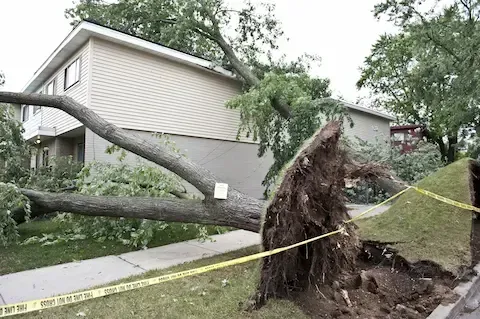
Not all trees carry equal risk in a wind event. Douglas firs are the most common failure tree in Oregon City because they are shallow-rooted by nature. Their lateral root systems spread wide but do not go deep, which means they depend on soil cohesion for stability. When that cohesion disappears in saturated clay, the whole root plate can lift and tip the tree in one piece. These are called windthrow events, and they are dramatic. The tree doesn't snap — it topples, bringing a disc of soil and roots with it.
Big-leaf maples are another concern. They hold enormous leaf mass by late May, and older specimens along fence lines and property boundaries are often structurally compromised by decay that isn't visible from the ground. Western red cedars, while generally more wind-firm than Douglas firs, can suffer significant crown breakage in sustained gusts above 45 miles per hour, which Oregon City regularly sees along exposed ridgelines in spring storm systems.
Terrain and Location Risk Factors in Oregon City
Where your property sits in Oregon City matters as much as what's growing on it. Properties along the ridgeline above Caufield Street and through the Hilltop neighborhood face direct wind exposure from systems moving northeast off the coast range. These elevated sites have little topographic protection and experience gusts that are noticeably stronger than what's recorded at lower elevations near the Willamette.
Properties along the I-205 corridor benefit from some buffering, but the corridor itself creates a channeling effect during high-pressure wind events. Neighborhoods in that zone, including areas near Thayer Street and the Beavercreek Road stretch, have seen repeated storm damage to Douglas firs that were otherwise considered healthy. Slope position also matters. Trees growing on the downhill side of a slope are structurally compromised from the start — their root system on the uphill side is truncated, and they lean into the fall direction naturally.
Signs a Tree Is at Elevated Risk Before a Storm
Visual inspection before a wind event can help you identify the trees most likely to cause damage. Look for these indicators:
Soil heaving or cracking near the base — this signals that root movement has already occurred during previous wind events
Visible lean that has increased over time — trees that lean toward structures are a direct risk if failure occurs
Crown dieback or dead branch clusters — internal decay often manifests as crown deterioration before the structural failure is visible
Fungal growth at the base or on the root flare — conks and bracket fungi indicate active wood decay inside the trunk
Previous damage from storms — trees that have already lost major scaffold branches have altered weight distribution and changed failure mechanics
None of these signs guarantee failure, but each one raises the risk profile and warrants a professional evaluation before the next storm system arrives.
What to Do Immediately After Wind Damage
When a tree fails on your Oregon City property, your first concern should be whether utility lines are involved. Your first concern should be whether utility lines are involved — PGE power line tree hazards are a real risk in this area, and you should contact PGE before any tree work begins.
If lines are clear, assess what the tree is resting against. Trees leaning on structures, fences, or neighboring property should be handled by a qualified professional. Tension and compression in a partially fallen tree create stored energy that releases unpredictably when cuts are made. The same caution applies after winter events — our guide to winter storm tree damage recovery in Oregon City covers what to check once the weather clears.
For urgent situations following wind events across Clackamas County, Emergency Tree Services can respond when a tree is actively threatening a structure or blocking access.
Reducing Your Risk Before Storm Season Peaks
The most effective strategy is assessment and preventive work done before the peak of storm season rather than after. A qualified arborist can identify which trees in your yard carry the highest failure risk and recommend structural pruning to reduce wind load, cabling to provide mechanical support, or removal when a tree is too compromised to retain safely.
Pruning done with wind resistance in mind is not the same as general cleanup pruning. It involves selectively removing weight from extended scaffold branches, opening the canopy to allow wind to pass through rather than push against it, and identifying co-dominant stems that are likely failure points. Done correctly, this kind of structural work meaningfully reduces the force a tree exerts on its root system during a wind event.
Oregon City's tree canopy is one of its most recognizable features. The Douglas firs lining neighborhoods off Beavercreek Road and the mature maples in Caufield and Hilltop areas are worth protecting. With a little attention before late spring storm systems arrive, most of those trees can stay where they belong — standing in your yard, not resting on your roof.
