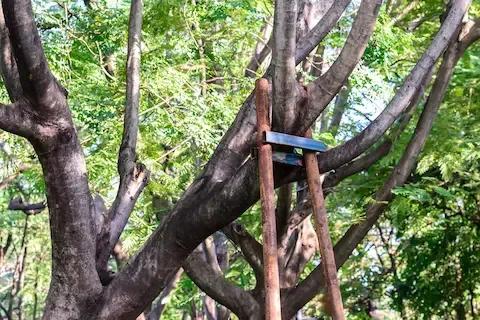
Bigleaf Maple Cabling Across Oregon City Yard Trees
Bigleaf maples are the defining trees of many Oregon City yards. Their sweeping canopies, deeply lobed leaves, and impressive scale make them beloved landmarks that homeowners want to protect for decades. But these same trees carry a structural vulnerability that becomes serious as they mature: codominant stems. When two or more trunks of nearly equal diameter rise from a shared union, that junction becomes a fault line. Wind, ice, and the sheer weight of an expanding canopy all push that union toward failure. Cabling addresses that vulnerability before catastrophe strikes, and understanding how it works helps you make smart decisions about the trees in your own yard.
What Codominant Stems Are and Why Bigleaf Maples Develop Them
Codominant stems form when two or more leaders compete for vertical dominance during a tree's early growth. Neither wins outright, so both grow upward with nearly equal diameter. The problem lies at the union itself. Unlike a healthy branch attachment—where wood fibers from the trunk and branch interlock—codominant stems often form included bark. That means bark tissue gets buried inside the union as both stems grow outward. Included bark acts as a wedge, preventing the wood from bonding properly and creating a structurally weak seam.
Bigleaf maples are prone to this pattern because of how aggressively they respond to early disturbance. A damaged or browsed leader during youth often triggers two or three competing replacements. By the time a maple reaches thirty years of age in an Oregon City yard, those competing leaders may each be twelve inches or more in diameter, and the union between them is carrying tens of thousands of pounds of canopy mass. That union may look solid from the ground, but X-ray vision into the wood would reveal a seam that is weaker than either stem individually.
How Cabling Reduces Splitting Risk at the Union
Structural cabling installs a tensioned steel or synthetic cable between two stems at a height typically two-thirds of the way up from the union to the top of the included canopy. The cable does not prevent movement. Trees are dynamic systems and need to sway in wind to build reaction wood and root anchorage. What the cable does is limit the maximum arc of sway, catching the stems before they reach the deflection angle at which the union fails.
Think of it as a safety net rather than a rigid brace. Under ordinary wind conditions the cable is slack or barely engaged. Under storm loading—the kind Oregon City sees during November through February when atmospheric rivers push sustained gusts across the Willamette Valley—the cable catches the load spike that would otherwise pry the union apart. That single intervention can add ten to thirty years of safe life to a tree that would otherwise be removed preemptively or lost to sudden limb failure.
The hardware matters. Stainless steel eye bolts drilled through each stem and a preformed dead-end termination at each end of the cable distribute load across the bolt shaft and surrounding wood without creating a stress concentration. Installation height is calculated so the cable length allows some sway but limits the moment arm at the union. Arborists following ANSI A300 cabling standards take measurements and load estimates into account rather than guessing.
Assessing a Bigleaf Maple Before Installing Cable
Not every codominant maple is a cabling candidate. The tree needs to be structurally sound below the union. Decay in the root flare, significant basal rot, or extensive hollow pockets in the lower trunk can mean the tree is beyond the point where cabling provides meaningful benefit. A certified arborist walks around the tree, probes suspect areas with a mallet for hollow sounds, and may use a resistograph drill or sonic tomograph on trees where internal assessment is critical.
The union itself gets close inspection. Included bark running deep into the crotch is a poor sign but does not automatically disqualify a tree. What matters is how much sound wood exists on either side of the included bark seam. If the sound wood is sufficient and the rest of the tree is healthy, cabling combined with selective weight reduction pruning on the longer, heavier stems gives the tree its best chance.
For homeowners in Oregon City's older neighborhoods like McLoughlin Heights or the historic district near Singer Hill, these assessments are especially worth doing. Mature maples in established yards took forty to seventy years to reach their current presence. Replacement planting gets you a five-gallon nursery tree and decades of waiting. Preservation almost always makes more economic and ecological sense when the tree is structurally salvageable.
Weight Reduction Pruning as a Companion Treatment
Cabling works best when it is part of a combined strategy. Reducing the sail area and end weight on the co-dominant stems decreases the load the cable must absorb. A certified arborist removes dead wood, crossing limbs, and long end-weighted laterals that amplify the lever arm on the union during wind events. The goal is not to shorten the tree or change its fundamental character—bigleaf maples have a natural spreading form that is part of their appeal—but to remove the structural liabilities that contribute to union stress.
Pruning cuts on bigleaf maple require attention to timing. Heavy pruning between February and October risks attracting western sap beetles, which vector Verticillium and other pathogens into fresh wounds. Late fall and early winter are the preferred window in the Oregon City area. Combining that dormant-season pruning with cable installation in the same mobilization saves a return trip and keeps wound exposure to the most favorable period.
Inspection and Long-Term Maintenance
A cable installation is not a set-and-forget fix. The tree continues to grow in diameter, and the hardware installed at year one will need inspection every two to three years to verify the bolt is not being encased by expanding bark rolls, the cable has not gone slack from stem growth, and the termination hardware shows no corrosion or fatigue. In Oregon City's wet winters, galvanic corrosion at the bolt threads deserves particular attention. Stainless hardware reduces but does not eliminate this concern.
If the tree grows significantly in diameter, a larger or repositioned cable system may be needed. Some mature maples ultimately need a supplemental rod brace at the union itself to address deep included bark. These decisions should be revisited at each inspection cycle rather than assuming the original installation is perpetually adequate.
For homeowners who want to understand the full range of structural support options available for yard trees, more on tree cabling bracing yard covers the broader cabling and bracing landscape including rod bracing, supplemental props, and when each technique applies. That context helps you have a more informed conversation with the arborist assessing your specific tree.
Choosing a Qualified Arborist for the Work
Cable installation is not a DIY project and not a task for a general tree trimming service without documented structural work experience. Look for an ISA Certified Arborist with a tree risk assessment qualification, and ask specifically about ANSI A300 part 3 compliance for cabling and bracing work. Ask to see photos of comparable installations and check that the contractor carries adequate liability coverage for work at height on large trees.
Proper tree bracing on a mature bigleaf maple is an investment that pays back over the life of the tree. A cabled tree that survives the next twenty Oregon City winters represents decades of shade value, ecological function, and property character that no new planting can replace on any reasonable timeline. Getting the installation done correctly the first time, by someone who understands the structural engineering behind the technique, is the decision that protects that investment.
