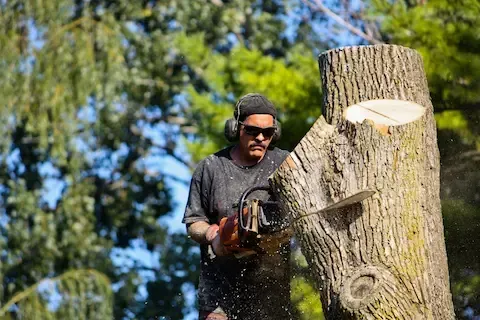
Crane Tree Removal Across Oregon City Hillside Lots
Steep hillside lots in Oregon City create challenges that flat-yard tree removal simply does not face. When a massive Douglas fir or oak leans over a roofline on a slope in Caufield, Beavercreek Road corridor, or the terraced neighborhoods above the historic district, standard climbing and sectional felling often puts the structure, the landscaping, and the crew at serious risk. Crane-assisted removal changes that equation by lifting large sections of the tree straight up and out of harm's way before they ever have the chance to land on something you care about.
What Makes Hillside Lots Different for Tree Removal
Oregon City sits along the Tualatin Mountains and the bluffs above the Willamette River, and much of its residential development follows the natural contour of those slopes. That topography means a significant portion of the city's older tree canopy grows on ground that tilts anywhere from fifteen to forty-five degrees. On terrain like that, several things change immediately:
Felling direction is restricted. On flat ground a climber has multiple viable drop zones. On a slope, the downhill side is often the deck, the fence line, the neighbor's roof, or a retaining wall.
Wood movement is unpredictable. Once a section is cut and begins to fall on a steep grade, gravity accelerates it in ways that are difficult to control with ropes alone.
Ground crew positioning is limited. Workers cannot always stand where they need to be when the terrain underneath them is sloped, loose, or saturated from Oregon's wet winters.
Access for equipment is narrow. Many hillside lots in Oregon City have long driveways, tight gate openings, or no vehicle access at all from the rear of the property.
These factors combine to make hillside tree removal one of the more technically demanding services in arboriculture. Crane work addresses most of them directly.
How Crane Removal Works on a Hillside Property
A crane-assisted removal does not mean the crane does all the work. It means the crane is positioned at a stable anchor point — typically the street, a driveway, or a cleared pad — and a climber ascends the tree to rig individual sections for lift. Each section is cut, lifted clear of any obstacle, and swung to a landing zone where a ground crew breaks it down for chipping or hauling. The sequence looks roughly like this:
The arborist crew assesses load points, overhead utility clearances, and the crane's reach relative to the tree's position on the slope.
A lead climber ascends and attaches rigging to a section near the top of the tree.
The section is cut and immediately controlled by crane tension rather than rope systems or natural fall.
Each piece comes out cleanly, traveling over the house, the deck, or the slope without contact.
The process repeats from the top down until the stump remains.
Because the crane controls descent rather than gravity, the risk of secondary damage drops substantially. This is especially meaningful on Oregon City properties where a single dropped section could roll fifty feet downhill before stopping.
When Crane Removal Is the Right Call
Not every hillside tree requires a crane. Smaller trees with adequate clearance can often be sectioned using traditional rigging. But several conditions point clearly toward crane work:
The tree overhangs a structure with no safe drop zone. If the only open ground is occupied by the house, the garage, or the neighbor's property, crane control is the practical answer.
The slope is too steep for safe rigging crew positioning. When the ground crew cannot stand safely beneath the tree, rope-based systems become unreliable.
The tree is dead, diseased, or structurally compromised. Weak wood does not behave predictably. Crane tension reduces the number of variables when a trunk might fail unexpectedly mid-cut. Our guide to dangerous tree removal and risk assessment in Oregon City explains how a crew grades that risk before deciding on a method.
The tree is large enough that sectional weight alone is a hazard. Mature Oregon white oak and Douglas fir sections can exceed a thousand pounds. Moving that weight with ropes on a slope is high-risk work by any standard.
In the neighborhoods along Linn Avenue, Beavercreek Road, and the hillside streets above Warner Milne Road, conditions like these appear regularly. Properties developed in the 1960s and 1970s frequently have mature trees that were planted close to structures and have since grown to dwarf them.
Cost Considerations for Crane Work in Oregon City
Crane removal costs more than standard removal, and that gap is real. Mobilizing a crane adds equipment expense and requires coordinating a larger crew. However, the cost comparison should also account for what crane work prevents: structural damage, emergency repair bills, neighbor relations, and the cost of removing a tree in a second operation after a failed first attempt.
Our breakdown of what tree removal costs in Oregon City covers the variables that push the price up or down depending on site conditions.
On hillside lots, crane work also often reduces overall project time. A tree that might take two full days of traditional sectioning with elaborate rigging setups can sometimes be cleared in a single day when crane lift replaces complex rope work. Reduced labor hours can offset part of the equipment cost.
Permitting and Utility Considerations on Steep Terrain
Oregon City has a tree removal permit requirement for trees meeting certain size thresholds on developed residential lots. On hillside properties, the assessment can also involve the city's erosion control guidelines, since removing a mature tree from a steep slope changes how water moves across that ground during the Willamette Valley's rainy season. A reputable crew will flag these considerations before work begins rather than after.
Overhead utility lines are a separate issue. Pacific Power and PGE serve much of the hillside residential area in Oregon City, and proximity to primary lines affects both how a crane can swing and whether a utility hold or coordination is required before the removal can proceed. This is not a step to skip.
Choosing a Crew with Actual Hillside Experience
Crane operation and tree work are both skilled trades on their own. When they combine on a steep Oregon City lot with limited access and a structure directly in the fall zone, the margin for improvisation shrinks fast. When you are evaluating crews, the questions worth asking are specific: Have they worked crane removals on sloped residential lots in this region? Do they own or contract the crane, and who operates it? What is the coordination protocol between the climber in the tree and the crane operator on the ground?
Oregon City's hillside neighborhoods are not forgiving of guesswork. The properties are close together, the terrain amplifies mistakes, and the trees are often large enough that a single error has consequences well beyond the property line. Crews that work these sites regularly understand the planning that has to precede the first cut.
